Friday, April 1, 2022

In Conversation: Are Diversity and Inclusion being Compromised in a Globalized World?


In a free-wheeling chat with Population First, Shajahan Madampat explores various dimensions of diversity and its role in creating sustainable and inclusive communities and nations. Shajahan is an Indian writer, critic, and social commentator based in the Middle East who writes on issues related to culture, media, and Middle East affairs in several leading publications including The Outlook Magazine, Gulf News, and Malayalam weekly magazines Kalakaumudi, and Mathrubhumi.

All the views expressed here are the views of Shajahan Madampat and should not be attributed to Population First.

There has been a tremendous focus on promoting cultural diversity over the past few years. What would you say is Cultural Diversity? 

I think cultural diversity is the equivalent of biodiversity in terms of people's belief systems, lifestyles, languages, literature, so on and so forth. So, if we start on that premise, perhaps it will be easier for us to develop a perspective on this because people have a better understanding of biodiversity. When we talk about culture and diversity, we are talking about essentially various modes and ways of living, in terms of languages, lifestyles, sartorial practices, religions and traditions. 

And this kind of celebration of diversity is one of the noblest democratic traditions. One can say that it is only when you have a secular democracy, diversity will be promoted, celebrated, and accepted. Secularism is the only political system, and culture, that allows unfettered freedom of expression, and lifestyles, so long as it doesn't violate some of the universal principles.  Diversity is a fact. Pluralism is what we make out of it

How has globalization affected cultural diversity, if at all?

When look at 10,000 years ago, the world was blessed with far more biodiversity than we have today. And in the next few decades, we will see a lot of species that will go extinct. The same is true of cultural diversity. If we look back a little before the advent of modernity, we would realize that the world was a much better place in terms of cultural diversity.

In fact, I must mention a beautiful essay by historian Shahid Amin titled  Post-colonial Towns Called Deoria. His point was that in his growing years if you travel 10 km, the kasbah or the town was totally different from the town that you just left behind. With the advent of globalization, what has happened is all towns have become similar. You have a MacDonald, you have a Pizza Hut, you have the same smell. People walk the same way, talk the same way. 

I grew up in the interiors of Malappuram district in Malabar in Kerala, and from the way somebody talks to me, I could say from which part of the district is he from.  Even now it hasn't completely vanished. But, with the strengthening of written culture, they all start speaking some kind of a standard language. I mean, we say in Kerala that Malayalam Manorama has killed the linguistic diversity in Kerala. 

The world after the advent of modernity in general and globalization in particular has been moving in the direction of some kind of homogenization in terms of language, culture, sartorial practices, body language. 

I recently came across a study that said that almost 70 or 75%, of the existing languages in the world would soon become extinct. So, languages are dying, distinctive cultural practices are dying. And then sometimes we turn all of them into demonstrable things. On a particular day, you will wear certain clothes e.g., a Diwali or Eid, or whatever. So that kind of shift away from wide or myriad ways of living into an easily definable kind of cultural appearance. That is what is happening now.

How important is Cultural Diversity in nation/ society building?

I was born and brought up in a very conservative Malabar Muslim family. The first time I celebrated anything other than Eid was when I was 16 and had the Onam feast at a Hindu friend’s place. And then, I started getting exposure to the rich diversity of Kerala because I had never travelled outside until that point. Then. I come to the JNU. And first, it was a cultural shock. Then it was a cultural feast. A Malayali Muslim with absolutely no exposure to the rest of the world, except through all the world classics, which I had read as Malayalam translations. So suddenly I am getting to know India. Nehru’s beautiful title always reverberates in my head, The Discovery Of India, as you interact with people from West Bengal, Orissa, Karnataka, northeast U.P., Bihar, Delhi, and Haryana. You slowly begin to understand how great we are as a diverse nation. Different ways of living. Different ways of eating. Different ways of talking. It was really a true microcosm and because of the kind of progressive admission policy, all strata of Indian society were represented in large numbers on campus because you have people coming from big urban cities and you also had people coming from remote rural India. And for me, that was the most beautiful experience. So cultural diversity is one of the most important things. That needs to be preserved almost as important as biodiversity.

How important is cultural diversity for sustainable development?

In the famous speech by Chief Seattle, the tribal leader belonging to the red Indian community, lies the answer. So, here are white people coming and occupying lands, either by force or offering to buy their land. Chief Seattle, addressing them speaks about how the land, the Earth, the sky, the trees, the animals, and the birds, all are an inalienable, organic part of  existence, and that land is not just a commodity, it is where the ancestors still continue to communicate with its people. Most of the traditional cultures across the world, for centuries, for millennia, lived in close harmony with nature. Through their life practices, they sustained life on Earth, they sustained Mother Earth, right?  In fact, the so-called modern world has a lot to learn from the sustainability practices of various non-modern cultures.

In the name of sustainable development, basically, there is an attempt at imposing the same approach on everybody, and it doesn't work that way. In fact, the way one community deals with sustainability may be totally different from the way the other communities deal with it. So again, the point is, sustainable development also has to include diversity. World Bank or IMF imposes the same set of activities and practices on so many different countries and cultures. It's not sustainable at all.

Many cultures reinforce and promote gender inequalities and injustice. How do we promote cultural diversity while addressing gender issues?

In various religious communities, traditional communities, families, etc. many regressive religious practices are sustained in the name of cultural authenticity and cultural preservation. Because within each culture, we have an elite, with vested interests. So, the men in a particular culture would like to ensure their supremacy over the women. Therefore, while celebrating cultural diversity, we also need to confront and eradicate many of the harmful practices that still exist. 

It is important to look at culture as a dynamic and vibrant entity, something that is changing all the time, adopting new things from outside, giving up some of the baggage of the past. All studies of different cultures around the world point to the truth of this.  No culture has been static. So, when we look at it from that perspective, we realize that a lot of internal criticism is important within each culture, within each community, because so many practices are sustained and preserved in the name of cultural identity and authenticity. They need to be confronted.


Tuesday, March 8, 2022

Spotlighting Budget 2022-23 For Gender Sensitivity


According to the ministry of women and child development website, “Gender Budgeting is a powerful tool for achieving gender mainstreaming so as to ensure that benefits of development reach women as much as men”. It goes beyond a mere accounting exercise to be an ongoing process of ensuring that the policies, programmes are not just formulated but are benchmarked, implemented, and reviewed to adhere to robust gender norms. This is done with a view to guarantee equitable distribution of budgetary allocations to achieve gender mainstreaming and set the stage for gender differential impacts. India had formally adopted this practice of a dedicated budgetary allocation way back in 20005-6 Since then all the incumbent governments have continued this practice.

So how does this year’s union budget stand up for the nearly 50% of the Indian population? Despite several strides made by the nation in various areas of development, inequities between men and women persist on many social indicators like health, education, economic opportunities, amongst others. In fact, the last two years have not just exposed these gaps but in many cases even widened them greatly. For instance, government statistics reveal that while the level of unemployment in men has gone back to the pre-pandemic mark, women are nowhere close to it and continue to be obviated from employment opportunities.  Further, disparities in access to healthcare, education, digital environment, and other facilities are gaining more distance. Do the allocations reflect an effort to stem this difference and ensure that both men and women are equal participants and beneficiaries?

While the budgetary assigning for healthcare especially mental health, digitalisation, and infrastructure strengthening may appear to bode well for bridging the gender gap, the limited number of participating ministries, as also the slight slump in the percentage of the gender budget to the total budget still reflects an apathetic attitude. The gender budget typically has two parts: Part A, which highlights the women-specific schemes, with 100% allocation for women, and Part B, which includes schemes where at least 30% of the allocation is for women.  Two schemes of the rural development ministry – ‘Pradhan Mantri Awaas Yojana' and Indira Gandhi National Widow Pension Scheme – comprise 82% of Part A.   The balance is distributed amongst Mission Shakti comprising Sambal with One Stop Centre, Mahila Police Volunteer, Women's Helpline, ‘Swadhar', ‘Ujjawala', Widow homes, and Samarthya which includes flagship schemes like ‘Beti Bachao Beti Padhao' and ‘Pradhan Mantri Matru Vandana Yojana’. Sambal has seen a reduced budget while Samarthya receives more funds over the last year.

Mr. Ravi Duggal, Independent Social, Public Health Researcher, and Activist speaking at a panel discussion on the budget hosted by the IMPRI Gender Impact Study Center, Impact and Policy Research Institute, New Delhi, noted that suggest that the budget appears to benefit the private sector greatly and is capital-oriented in nature. There has been a reduction in several welfare schemes such as MNREGA, food subsidies, rural livelihood, etc, and the funds, he highlighted, have been relocated to help the private sector. The panel discussion was held on 3 February 2022 and was chaired by Prof. Vibhuti Patel, Visiting Professor, IMPRI.

 Pandemic has had a devastating effect on women’s health as has been shown by several reports. Even though there are proposed mental health helplines, the question of it truly benefitting the womenfolk becomes pertinent as a large number of women, more rural than urban either have access to technology or are well versed in its usage. Jasodhara Dasgupta, Co-Convenor, Feminist Policy Collective, drew attention to the NFHS-5 report which reveals that anaemia levels in women have gone up across all age groups. Yet, she notes that the budgetary allocations to address this situation by increasing spending on PDS or on mid-day meals are dismal and, in some cases, have actually declined after adjusting for inflation.

Renu Khanna, Trustee, SAHAJ, Vadodara; Member, Feminist Policy Collective, another panellist at the discussion, highlighted that the health budget has only been allocated 2.26% of the total budget even though health expenditure as a percentage of total expenditure was 2.46% in the year 2020-21. According to her, we should have seen major allocations to the Health sector given the problems faced by people in India during the COVID-19 pandemic. Also, as a part of its planning, it fails to address the massive digital divide between males and females in India where only 21% of Indian women use mobile internet compared to 42% of men, which can have major fallouts in education, health, and overall wellbeing of the citizens.

This union budget has increased the portion of infrastructure spending. However, this move could benefit men only as over the years, the women labour-force has registered a declining presence in the sector, cautioned Prof. N. Manimekalai, Professor, Director, and Head, Department of Women’s Studies, Bharathidasan University, Tamil Nadu. Women’s participation has traditionally been low, Pandemic has further forced women to move to casual labour, and they have had to manage work with household chores. The ecosystem for employment of women has always been poor, the budget has offered no positive direction for women’s employment, in fact, its thrust on digitalization has further created more uncertainty.

Prof. Manimekalai further highlighted the disparity in the self-employment and entrepreneurship sector. While women-led enterprises are increasing, their marketing is not enough, hindering their competency. They propound that women and child protection schemes are lacking, and the capital expenditure-led budget does not address these lacunae. There is an urgent need to acknowledge the employment crisis, universalize PDS allocation, strengthen SHGs, and provide better social protection to ensure more robust female participation.

Seema Kulkarni, Founding Member, Society for Promoting Participative Ecosystem Management (SOPPECOM), Pune; Member, National Facilitation Team, Mahila Kisan Adhikar Manch (MAKAAM) spoke about agriculture and allied activities and how the budget was focused primarily towards privatization. She felt that the budget allocation for the agriculture sector did not give clarity on the allotment for its different components and underlined the importance of recognizing the engagement of women in agriculture. There is a definite need for policies that support and encourage gender diversification in the sector. Citing the example of women’s access to credit as a case in point, she noted that the Census of India points out that only 26% of female cultivators have access to direct agricultural credit.  It is a matter of concern as it highlights the unequal access to resources. Over the years, the proportion of women bank account holders has increased significantly even though women’s access to credit is abysmal. It is important to document women workers and provide improvement in the advancement of women’s rights over land, nature, and forests. 

Gender Budgeting has been pitched as a tool to rectify the gender inequity and ensure that benefits of socio-economic development reach women as much as men. This necessitates greater participation of all ministries. While there has been a rise in the number of participating ministries, the number is still very dismal, noted Dr. Sanghamitra Dhar, Technical Coordinator (States) – Gender-Responsive Budgeting, UN Women. This lays the ground for a limited formulation, and reach of gender-equitable policies. Capacity building and sensitizing of ministries in gender budgeting is a critical prerequisite for a more just society.

Women, constitute 48% of India’s population, but they lag behind men on many social indicators. Hence, they warrant special attention due to their vulnerability and lack of access to resources, if the country has to make a place globally as one of the truly progressive nations. As Ravi Duggal said during the course of the discussion, the gender budget statement should be developed by undertaking gender audits and that we need to focus on strengthening gender-disaggregated data. Prof Vibhuti Patel summed up the entire discussion stating that the Union Budget 2022-23 is silent on the concerns of social protection and has not focused on issues of inflation, access to education, and healthcare for all. 


Tuesday, July 27, 2021

Medal or motherhood?

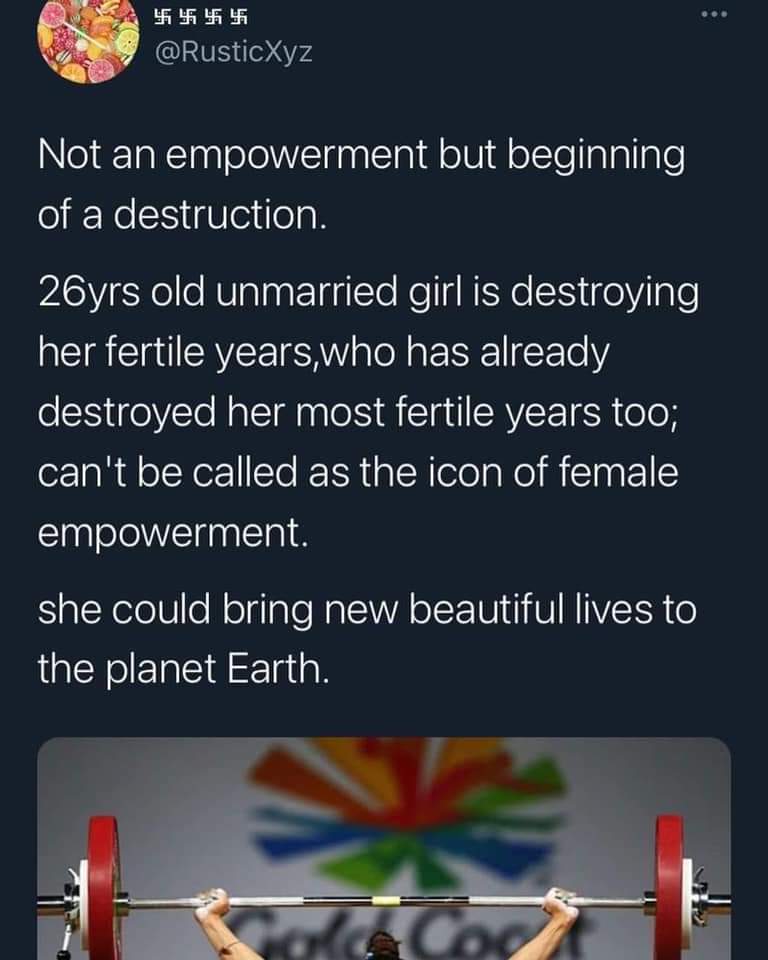
The original tweet


Even as the whole of India is celebrating weightlifter Mirabai Chanu winning a silver medal at the ongoing Tokyo Olympics, there are some people condemning her on social media for 'destroying her fertile years' (Instead of lifting weights) 'she could bring new beautiful lives to the planet earth'!
We were not surprised by this comment as we see much of the society around us still harking on the centuries-old patriarchy. We believe that a woman, or any person, should have the freedom to choose what they want to do in life. To have a child or not, when to have a child, how many children to have are personal choices of a woman. The least we can do is to empower her to do so.
On the other hand, can we call this gaslighting by a man? Of course, we are assuming the person who wrote this on Twitter is a male. Maybe it shows our gendered mindset because women could be as and sometimes more patriarchal than men. This tweet, by a person whose gender one may never find out, assumes that a woman has to bear a child/children, of course within marriage - though it is not explicitly mentioned in the tweet. It also says that personal ambitions and aspirations of women are detrimental to society.
How about sportsmen and the impact of the physical activity on their fertility? A Cleveland Clinic report says, "Decreased seminal parameters and sex hormone levels have been reported in male athletes and, therefore, a possible impairment of male fertility has been linked to exercise in a volume, intensity, and modality dependent-manner."
So, should we consider that sports are harmful and detrimental to society and ban the Olympics?
It is inspiring to read about the hardships Mirabai had to face to reach where she is today. Mirabai could visit her parents only for a few days in a year, for the past few years; she has been training so hard for this glorious moment. She is passionate about the sport and she has been working extremely hard to get better at it.
We can't forget that in a country, where (Men's) Cricket is the only sport talked about, a person from a remote state, away from the modern facilities, and living in extremely difficult circumstances has got India its first medal in the Tokyo Olympics.
She is to be commended, not condemned. If she wants to be a mother, she will. Whenever she wants. Some sportswomen are mothers and are competing and winning. One of the names that comes to our mind is Mary Kom, who is bringing up three kids and continues to compete. So who says pursuing a sport and motherhood are mutually exclusive?
The most heartening thing is that the tweet has not gone down well with the Twitterati. However, rather than shouting the person down and making him a social media celebrity, we may consider having public conversations on such opinions and statements to challenge the deep-seated patriarchal mindsets.

#tokyoolympics #gender #women #mirabaichanu

Thursday, December 10, 2020

The ‘Bois Locker Room’ incident from Delhi has shaken and shocked the parents and teachers and garnered considerable media attention in May 2020. The boys from a social media group shared obscene images of fellow underage girl students, passed sexually explicit and offensive comments. There were discussions of raping these girls and threats to ‘kill’ them, etc. We at Population First wanted to know what was prompting the boys to engage in such conversations and how boys perceived this incident. An online survey was conducted with 226 boys of which more than three fourth were active on social media platforms such as WhatsApp and Instagram. 

Here is what we found out. 

Do let us know your views and any proactive steps you have taken to initiate conversations with boys on sex and sexuality. To stop violence against girls, we need to start talking to boys to counter the misogyny that is so widespread in our society.

Sunday, October 18, 2020

 OUR OWN OSCAR- BHANU ATHAIYA 

A tribute by Dolly Thakore


Bhanu Athaiya receiving Laadli Lifetime Achievement Award, 2011-12 at NCPA with Dolly Thakore, Ashutosh Gowariker and Dr. A.L.Sharada

THE FIRST THING I DID when I got news of Bhanu Athaiya passing away, was reach out for the book THE ART OF COSTUME DESIGN by BHANU RAJOPADHYE ATHAIYA above my bed.

And on the opening page found her inscription which read: To Dearest Dolly, to all the wonderful memories we have shared on GANDHI and through the years – Bhanu Feb. 23, 2010.

That was the day she had launched her long overdue book  on her career at the Taj Landsend, in Bandra. And I had the honour of launching her book along with Kamini Kaushal with whom Bhanu had worked on her first film project AAS in 1953.

I first met Bhanu at my friend actor Nadira’s home on Pedder Road somewhere in the early Seventies. And my first conversation with her was about Shree 420, and how I imitated Nadira in MUD MUD KE NA DEKH as a little girl. And she told me she had designed all costumes for Raj Kapoor including the dress Nadira sang that song in!

At that time I was cast as Stella in Alyque Padamsee’s play STREETCAR NAMED DESIRE.  And I had the audacity to ask if she would design my costume. She agreed immediately.  I knew we could not afford this great Film Costume Designer. But with great trepidation I landed up at her workshop in a garage in Shanker Mahal. Within seconds she sketched the low- waisted blue dress I wore in the play….and didn’t charge me a paisa!

How then could I have loved anyone more than her!!!

Then came GANDHI… and my first suggestion to Sir Richard –later Lord Attenborough – for a Costume Designer was Bhanu. As Richard himself writes in his foreword “It took me 17 long years to set up Gandhi, my dream film, and just 15 minutes to make up my mind that Bhanu Athaiya was the right person to create the many hundreds of Indian costumes that would be required to bring it to the screen”.

During the filming of Gandhi for almost a year, some of us had permanent residence at the Ashoka Hotel in Delhi. While most of us preened through its corridors boasting about working on the film, Bhanu was seldom seen anywhere. She worked quietly behind the scenes visiting the lanes of Delhi and accessing tailors and cutters for the hundreds of pyjamas and kurtas that would roll out in trucks on the day of the shoot. She once shared her despair at making nothing but pyjamas! But after the Oscar Award she confided what a challenging job it was choosing the right fabric and cutting the pyjamas for people in different regions of India. Each had a specialty of its own. And never once did we hear her make a demand or complain!

In all the years I have known her, her image never changed. Her glamorous head of jet black hair professionally coiffure framed her smile as she glided elegantly in sophisticated chiffon sarees. Her last visit to my home was in August 2014, when I hosted a gathering of some of the cast and crew of Gandhi to remember Sir Richard’s passing away that week. She sat demurely on the diwan…acknowledging those she recognized, and gave me a long lasting hug. This was my Laadli of the Year 2012.

For me one of the most exciting responsibilities as the Coordinator of National Laadli Media  Awards is of suggesting someone for the Laadli Lifetime Achievement Award. Shuffling through all the women achievers I had encountered in my life from the vast canvass of media oriented pursuits one name that jumped out was Bhanu Athaiya. And in the field of film costume designing by any women the choice was easiest. No woman had  designed more costumes for more successful popular films for over 50 years and for the most popular banners and directors and actors than Bhanu Athaiya.

And remembering all those encounters brings a tear to my eye even today. Goodbye Bhanu. There will never be another like you.

Wednesday, September 30, 2020

Salute to translators all over the world


A friend recently wrote a post on Facebook in Marathi after seeing a rainbow in which she used the words 'rangancha fatkara', रंगांचा फटकारा that was translated into English as a 'slap of colours.' Fatkara is a splash, while a slap is fatka फटका. This translation is done by artificial intelligence or AI and it proves the need for good translators. 

The need for translation from one language to another is felt strongly in a country like India, a land where hundreds of languages are spoken/written, if we include the dialects. While some languages may have many common words, for example Marathi and Kannada, or Marathi and Gujarati, some are totally different from each other. More so, the same word may convey something entirely different in two languages. For example, shiksha in Hindi is education, while it's punishment in Marathi. Given this scenario, the ability to know more languages than one's mother tongue is decidedly advantageous. Such people, the translators, who can understand one language and put the meaning across in another, make it possible for a native Marathi speaker /reader like me to enjoy literature in Bengali written by Rabindranath Tagore or Sharat Chandra Chatterjee, in Kannada written by Bhairappa or Vaidehi, in Spanish by Marquez. I will always remain grateful for their hard work; but for them, I would have missed the beauty of Tagore's stories, Sharad Babu's novels, Bhairappa's version of the Mahabharata, and the magical realism of Marquez. 

Translators are in great demand these days mainly from companies working in the field of AI. Once you have fed the computer with the translations of certain words, there is no need of a living person to do the translation for you. The translated versions of various posts and comments that we see on Facebook in languages other than the one we use, are provided automatically, i.e. by AI. Of course, AI works on the basis of words fed to it by living persons, but the database doesn't have a context for the words to be translated. It is done to cut costs and thus very often we come across advertisements or subtitles that are incorrect, hilarious, annoying, and irritating. The message in the advertisements may reach the reader but the words definitely lose their original shine. People who work as translators complain that they are not given their dues, respect, pay, or credits.
The world is a richer place because of translators who quite literally transport the reader of one language and culture to the language of the original writing, the reader gets a feel of the alien culture, food, fashion, cities, housing, etc. She may dream to travel to this land someday.

Although it is said that 'much is lost in translation', whatever remains is also valuable. No doubt, the 'lost in translation' feeling is sometimes prominent while watching the film in a language we don't understand. Sometimes the subtitles don't match the actions on the screen, sometimes the beauty or the literary value of a song is lost in a literal translation. Subtitling has gained momentum as a skill or an art in recent years and that has benefited viewers across the globe. Viewers who love web series, films, documentaries made in different countries and in different languages.

A heartfelt thank you to the translators on this International Translation Day.
We at population first value translators and had awarded an incredible book Romantic Encounters of a Sex Worker written in Tamil by Nalini Jameela and Translated into English by Reshma Bhardwaj.

Mrinmayee Ranade
Communications Consultant
Population First

Monday, August 3, 2020

BREAST IS THE BEST, OR IS IT?

A relook at common wisdom


DR SHANTANU ABHYANKAR, WAI


Image Source: Google

Breast milk invigorates and nourishes the newborn like nothing else. It’s the baby’s first food, ensuring good health right into adulthood. Not surprisingly, almost every Bollywood hunk has sworn to the goodness of ‘Ma ka doodh’ on screen.

Successful breast feeding is the rich dividend following investment in the form of prenatal counselling, good preparation, a positive attitude, institutional and government policies and time.

‘Breast is the best’ and we need lactation friendly facilities even in public spaces. But there can be exceptions. The dictum, that all mothers should feed all babies, exclusively for six months, needs to be looked at again. Some special situations need to be factored in.

Such blanket advice overlooks the physical, social and economic constraints of the mother. Ignorance or unwillingness to try hard enough aren’t the only reasons why a mother gives up breastfeeding. Many mothers need to get back to education/earning due to socioeconomic reasons. A six month sabbatical may not be affordable. If the cost of time invested, cost of giving up a job, refusing a promotion or a raise, is factored in, we will realize that breastfeeding isn’t cheap and certainly not free.

Over glorification of breastfeeding can create guilt in the minds of women forced to give it up. Such mothers need positive support without guilt and judgment. Of course it is the mother's duty to feed the newborn but then it is the father's duty as well. It’s the responsibility of the family too. In fact just as not procreating is a personal choice, not breastfeeding can be a valid personal choice and needs to be respected.

Low birth weight and preterm babies can accept only small aliquots of milk. They may not be able to cry aloud and are too weak to latch effectively and suckle vigorously. They need to be fed every hour or two, for the first three to four months. This leads to sleep deprivation and a lot of other physical and psychological challenges. In such situations, milk substitutes under medical supervision, may be given a thought. Insisting on exclusive breastfeeding can be counterproductive. The baby needs to be well fed and well-nourished; the source matters little in the face of such adverse conditions.

Babies larger than expected, especially those born to diabetic mothers, become too hungry, too soon. They may need supplement, till lactation is properly established.

Even normal babies often suffer hunger, for lactation is not well established in the first few days of life. The standard medical response to this is; ‘in the first few days of life, all that is secreted is all that the baby requires’.

However hunger in the early days of life can be life threatening. Emergency NICU admission with intravenous glucose may become necessary. Long term neurological consequences of unrecognized low blood sugar can be disastrous. Hunger leads to excessive crying, lethargy, dehydration, convulsions, very low blood sugar and even sudden death.  

The mother is exhausted after labor and readily breaks into tears when she realizes that she is failing to feed the child. This inferiority complex and accompanying anxiety leads to reduced milk flow. Elderly mothers, comorbidities, cesarean section, a baby girl when a boy was expected; are stressful enough. A wailing toddler due to failed lactation is the last thing one would want. Lactation doesn't happen instantaneously. Suckling happens to be the strongest stimulus but suckling the child every two hours is easier said than done. Delayed onset of lactation is neither the mother’s fault nor the baby’s.

Traditionally such problems have been tackled with wet nurses, cow’s milk etc. Since milk powder is sterile and has known constituents in known proportion that closely match the composition of human milk, it’s preferred over animal milk. Some cities now boast of milk banks, which is a good option too.

Breastfeeding is the obvious choice between sumptuous feeds and milk substitutes. However between reconstituted milk powder and emergency intravenous glucose; milk powder is obviously the better choice. Substitutes create problems because of improper reconstitution and unsafe water. We've made a lot of progress as far as safe drinking water is concerned. A properly constituted and safely prepared powdered milk is a good option. It is important to see that the baby is adequately and safely fed till the time lactation is well established. Once that happens, top feeds should be stopped forthwith.

Policies supporting milk substitute appeasing the market forces and abetting profiteering are bad but milk substitutes aren’t bad by themselves. Milk and milk substitute should be used judiciously according to their wishes needs and abilities off the mother and her family.